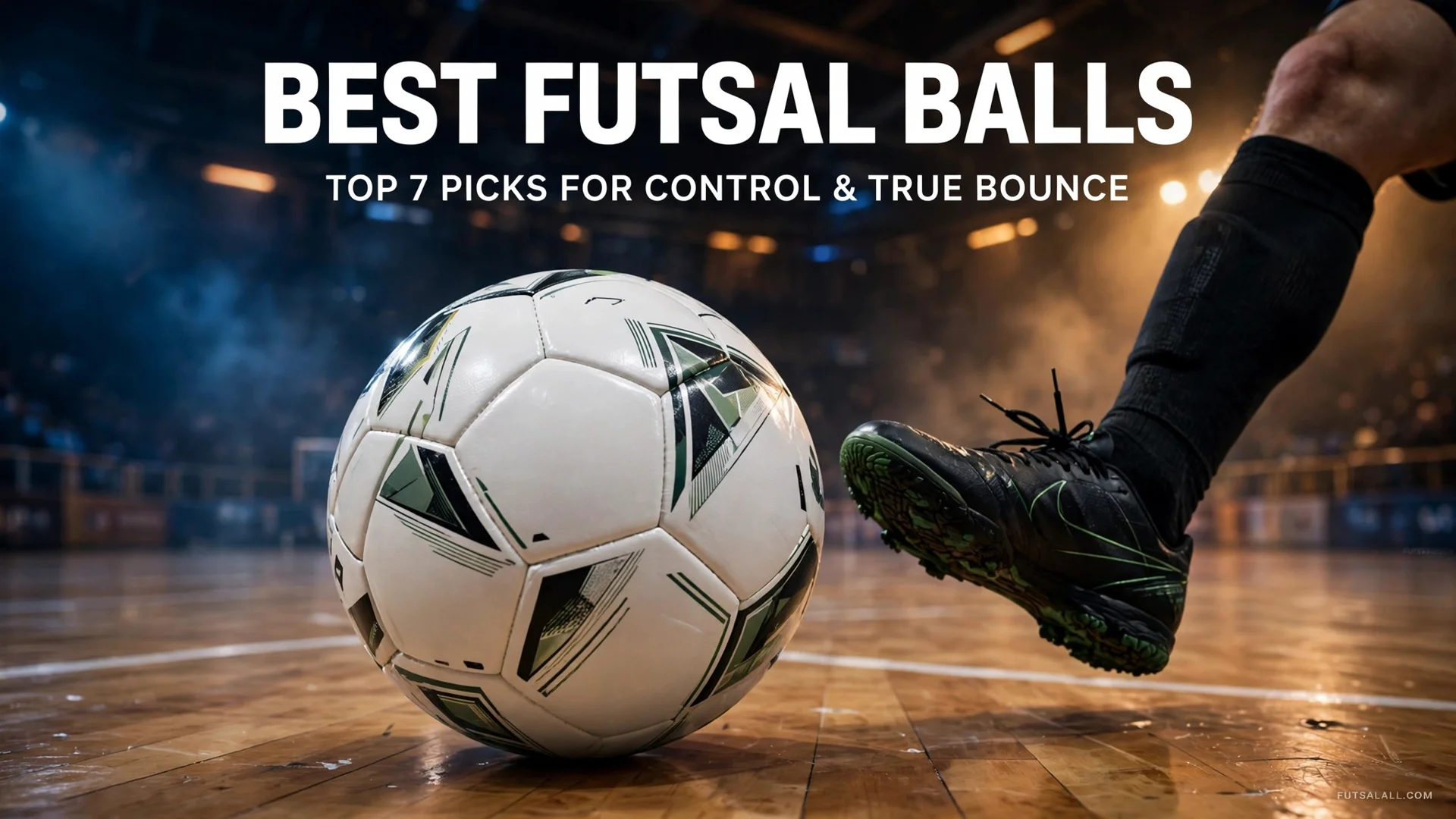
Best Futsal Balls: Top Picks for Control, Durability and True Low Bounce
Bring a regular soccer ball onto a futsal court and the game falls apart within minutes. The ball pings off your foot, bounces up to knee height off the hard floor, and every first touch becomes a chase. That is not a skills problem — it is an equipment problem. A proper futsal ball is built differently on purpose: smaller, a touch heavier for its size, and engineered so the bounce stays low and honest.
That low bounce is the whole soul of the sport. It keeps the ball on the floor, rewards close control, and makes the fast passing game possible — the game we break down in our guide to what futsal is and how it is played. Whether a listing calls it a futsal ball, a ball futsal or a sala ball, the test is the same: size 4, official weight, and a rebound that dies instead of jumping.
Below are the six futsal balls we would actually spend money on — from a premium match ball to a budget training workhorse — plus the official size, weight and bounce standards, so you can check any ball against the rules before you buy it.
Quick Picks
| Ball | Best for |
| Senda Vitoria Premium Match | Best match ball overall |
| adidas Tiro League Sala | Seamless touch for training and matches |
| Nike Futsal Maestro | Grip and easy availability |
| Mikasa SWL62 | Classic club training |
| Select Jinga | Best budget pick |
| Senda Belem Training | High-volume club and academy training |
Futsal Ball Size, Weight and Bounce — The Official Standards
Every ball in this guide is judged against the same rulebook: Law 2 of the Futsal Laws of the Game. If a ball does not meet these numbers, it is not really a futsal ball, whatever the packaging says.
| Standard | Official futsal ball |
| Size | Size 4 (standard for ages 12+ and all adult/pro play) |
| Circumference | 62–64 cm |
| Weight | 400–440 g at the start of the match |
| Bounce | First rebound of 50–65 cm when dropped from 2 m |
| Compared with a soccer ball | A size 5 football (68–70 cm) rebounds roughly 100–150 cm in the same drop test |
Two things surprise new players. First, the futsal ball size is smaller than a football but the weight range is almost the same, which is why a futsal ball feels dense and “dead” in the best possible way — it goes where you strike it and stays there. Second, the bounce rule is a range, not a suggestion: below 50 cm the ball would feel like a stone, above 65 cm it starts behaving like a football and the court’s whole rhythm changes.
Younger players step down a size: junior futsal is usually played with a size 3 ball, lighter and easier to control while technique is developing, before moving up to the standard size 4.
The 6 Best Futsal Balls
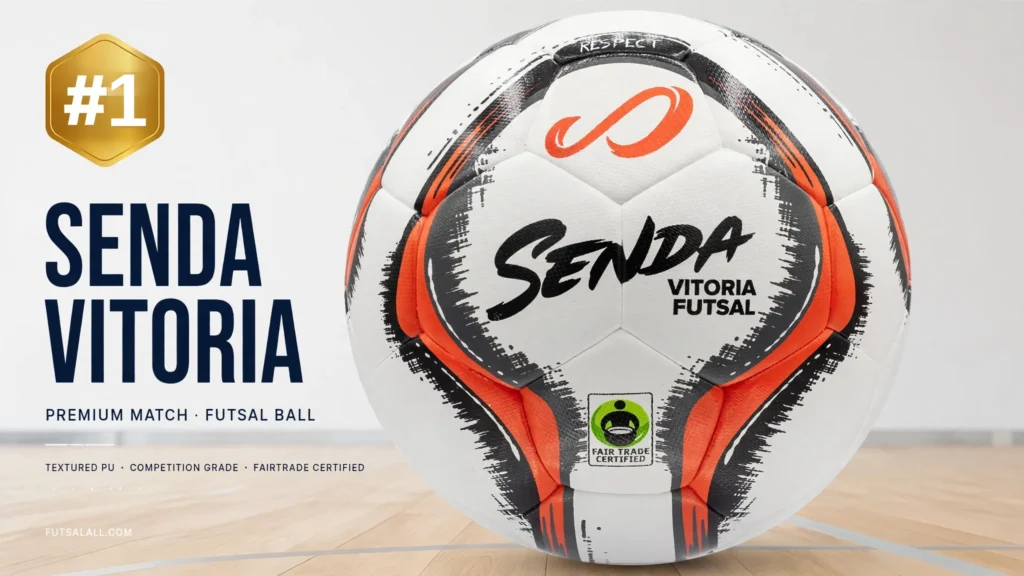
1. Senda Vitoria Premium Match — Best Match Ball Overall
Senda built its name in futsal and street soccer, and the Vitoria is its premium match ball. The headline technology is the patented DuoTech construction: the panels are both stitched and glue-bonded, a hybrid approach Senda says outlasts purely machine-stitched or hand-stitched balls while keeping a bonded ball’s consistent shape. The cover is a premium textured PU — the same family of surface used on top-level match balls — so the grip you need for sole control is there from the first session.
It is a true low-bounce ball, built to maximise control in small spaces on hard courts, with a reinforced bladder that holds air longer between inflations. Then there is the part no other ball on this list can claim: every Senda ball is Fair Trade Certified, made in a factory where child labour is banned, workers are paid a living wage and part of the proceeds goes back to their communities. It comes with a one-year warranty on shape and construction. A match ball that plays properly and is made properly — easy to root for, easy to recommend.
Cover: Premium textured PU, DuoTech stitched-and-bonded construction
Bounce: Low bounce, designed for hard courts
Certification: Fair Trade Certified; 1-year shape and construction warranty
Sizes: Size 4 (size 3 also available)
2. adidas Tiro League Sala — Best Seamless Touch for Training and Matches
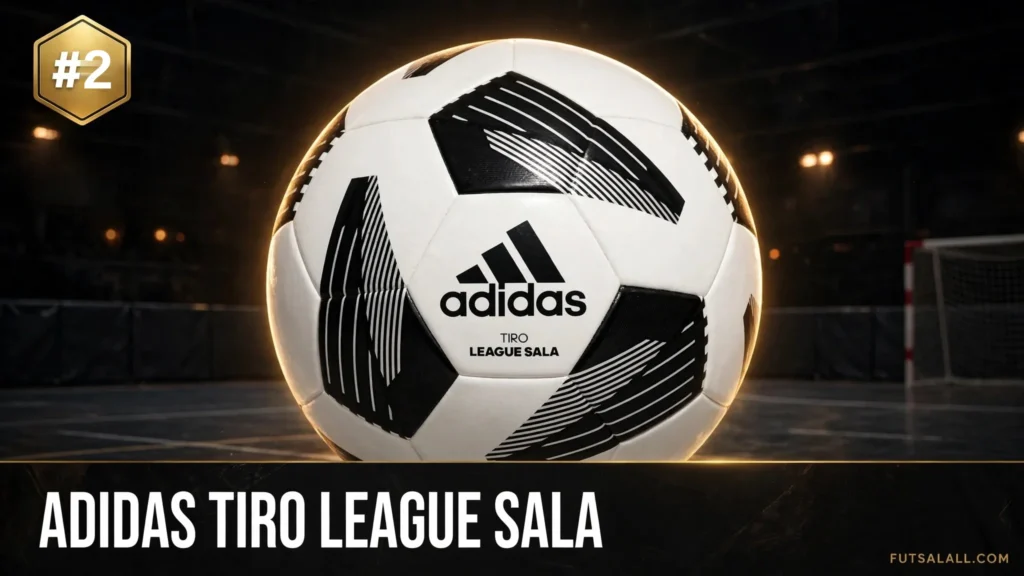
adidas calls its futsal line “Sala”, and the Tiro League Sala sits in the sweet spot of that range: a ball built to match-ball standards that is tough enough for weekly training. Its party trick is the TSBE construction — a seamless, thermally bonded surface with no stitches to catch, peel or let water in — wrapped in a durable 100% TPU cover.
The futsal-specific part is hidden inside: a low-rebound butyl bladder (adidas uses a fibre-filled futsal bladder design in its Sala balls) keeps the bounce low and the control tight, while butyl’s natural air retention means you are not reaching for the pump before every session. The ball fulfils the International Matchball Standard (IMS) testing criteria, so its size, weight and rebound are properly verified, not just claimed. For clubs that train twice a week and play on the weekend, this is the one-ball solution.
Cover: 100% TPU, TSBE seamless thermally bonded construction
Bounce: Low rebound futsal bladder
Certification: IMS (International Matchball Standard)
Sizes: Size 4 and size 5 Sala versions are sold (choose size 4 for futsal)
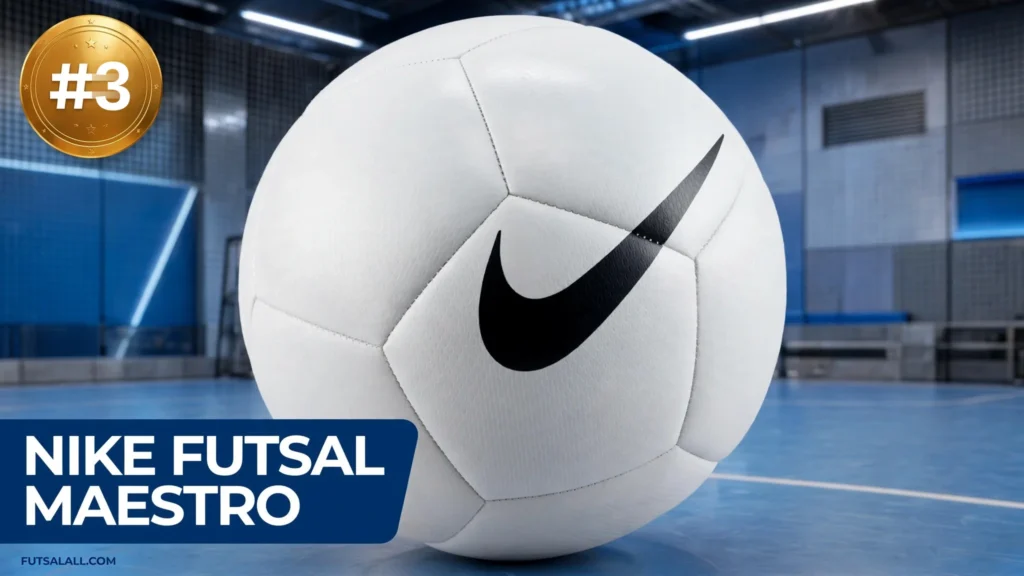
3. Nike Futsal Maestro — Best for Grip and Easy Availability
Not everyone can order specialist balls easily, and that is exactly where the Nike Futsal Maestro earns its place. It is a proper futsal ball — official futsal size and weight, smaller and heavier than an outdoor ball so the bounce stays down — and you can find it in big sports retailers almost anywhere in the world.
The build is straightforward and sensible: a textured casing that gives a consistent, grippy touch for passing, shooting and dribbling, a machine-stitched casing that holds its shape, and a rubber bladder that keeps air in well between sessions. The 12-panel design flies true on the short passes and driven shots that make up most of futsal. It will not give you the premium feel of the Senda Vitoria, but as a first real futsal ball — or a club’s reliable spare — it does the job properly, and it pairs with the right footwear from our best futsal shoes guide to complete a beginner’s kit.
Cover: Textured casing, machine-stitched, 12-panel design
Bounce: Low bounce — smaller, heavier futsal design
Certification: Official futsal size and weight
Sizes: Size 4
4. Mikasa SWL62 — Best Classic Club Training Ball
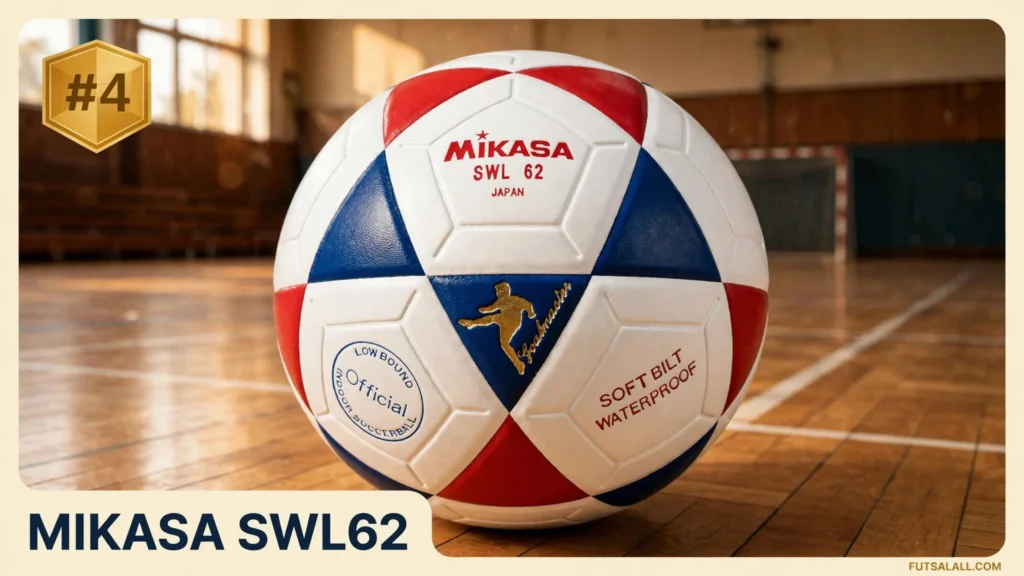
Mikasa’s SWL62 has been a fixture of school halls and club training nights for years, and there is a reason coaches keep reordering it: it is a simple, honest low-bounce ball that shrugs off hard use. The PU outer gives a firm, predictable touch, and the ball is made to the official size 4 futsal dimensions — a 62 cm-class circumference that sits in the legal window.
This is not a ball that chases match-ball glamour. It is the ball that lives in the equipment bag, gets used on wooden floors, sports halls and the occasional rougher surface, and keeps its shape season after season. For academies buying in quantity, or a team that needs training balls that behave like the real thing without match-ball money, the SWL62 is the old reliable.
Cover: Polyurethane (PU)
Bounce: Low-bounce design for indoor courts
Certification: Built to official size 4 futsal specifications
Sizes: Size 4
5. Select Jinga — Best Budget Pick
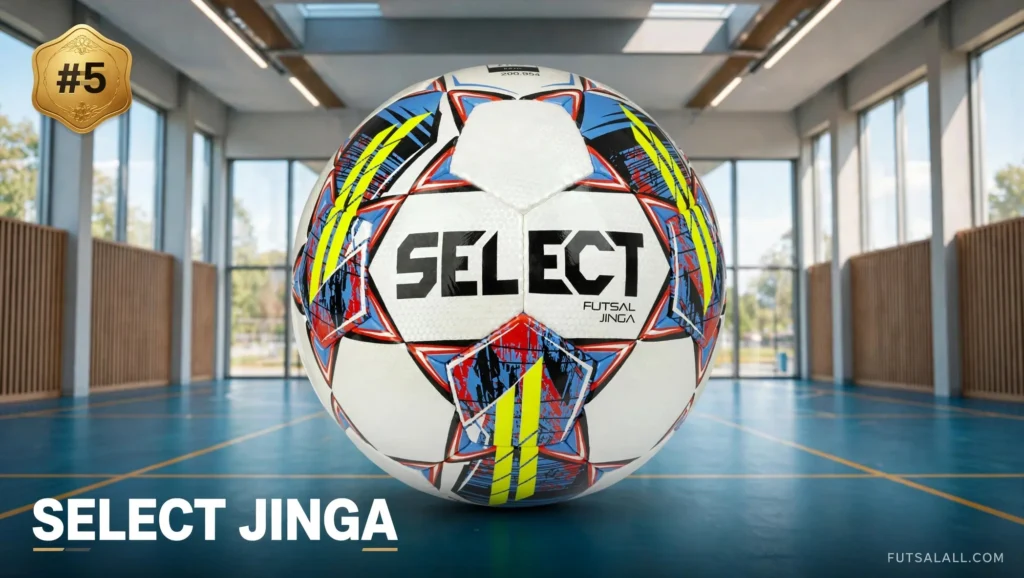
Not every good futsal ball has to cost match-ball money, and the Jinga is the proof. It has been one of Select’s best-selling futsal balls for years — Select is the ball sponsor behind the major US futsal leagues — and the V22 version pairs a durable, patterned PU cover with colourful graphics that make the ball easy to track under hall lights. The panels are hand-stitched with smooth transitions between them, which keeps the ball properly round and predictable under your sole.
Inside, a butyl bladder wrapped in polyester fibres holds the rebound where futsal needs it: low and consistent, first bounce inside the official window. The Jinga carries FIFA Basic approval, meaning its size, weight and bounce are independently tested against the official standards (62–64 cm, 400–440 g, 50–65 cm rebound) rather than just printed on the box. It sits a tier below the FIFA Quality match balls above it on this list — that is the honest trade at this price — but for training and league play on a budget, it gives you a genuine futsal ball from a specialist maker, with a one-year warranty behind it.
Cover: Durable patterned PU, hand-stitched panels
Bounce: Low bounce — butyl bladder with polyester fibres
Certification: FIFA Basic
Sizes: Size 4 (junior size 3 also available)
6. Senda Belem Training — Best for High-Volume Training
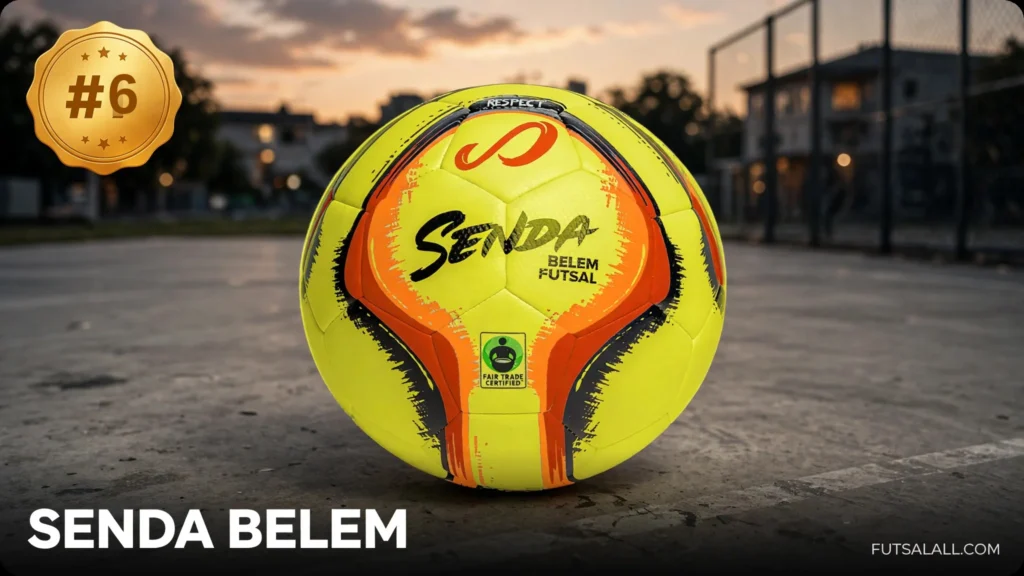
Every club needs balls it is not precious about — the ones that take five hundred shots a week in training — and the Belem is Senda’s answer. It is the Vitoria’s training-grade sibling: machine-stitched rather than DuoTech, built for volume and durability, and sold at a training-ball price rather than a match-ball one.
It keeps the important things intact. The bounce is the low, controlled rebound futsal training demands, it is Fair Trade Certified like every Senda ball, and listings include a one-year shape and construction warranty — rare peace of mind at this level. Sizes run from junior size 2 and 3 up to the standard size 4, which makes it a smart one-model choice for academies kitting out every age group. Buy three, train hard, and save the match ball for match day.
Cover: Machine-stitched training construction
Bounce: Low bounce, tuned for training
Certification: Fair Trade Certified
Sizes: Sizes 2, 3 and 4 (size 4 is the standard adult futsal size)
How to Choose the Right Futsal Ball
Start with your surface. Polished indoor wood and proper sports-court flooring suit any ball on this list. If your game happens on concrete, asphalt or rough outdoor courts, durability becomes the first filter: bonded and machine-stitched training balls like the Belem and the Maestro will outlast delicate premium covers, which are made for halls.
Check the bounce before anything else. A ball can be the right size and still be wrong. Drop it from head height in the shop — a real futsal ball should come back to roughly a quarter of the drop height, not bounce happily up to your waist. The official test is a 50–65 cm rebound from 2 metres; your hand test just needs to confirm the ball wants to stay down.
Feel the grip. Futsal is played with the sole of the shoe, so surface texture matters. Textured and lightly structured covers (the Select’s diamond pattern, the Senda’s textured PU) hold the ball under your foot during rolls and turns; a glassy smooth cover skates away. Whatever position you play — and every role from fixo to pivot lives on first touch, as our futsal positions guide explains — grip is control.
Stitched, bonded or hybrid? Thermally bonded balls (adidas) give the smoothest, most consistent match feel and shrug off moisture. Machine-stitched and hand-stitched balls (Maestro, Jinga, Belem) are tougher bargains for heavy training. Hybrid DuoTech (Senda) splits the difference. There is no wrong answer — only the wrong ball for your court and budget.
Match the tier to your game. Premium (FIFA Quality match balls) for league play. Mid-range seamless and IMS balls for serious training and club matches. Budget training balls for volume work and youth groups, in junior sizes where needed.
Futsal Ball Care
A good futsal ball should last seasons, not months, and most early deaths are care mistakes. Inflate to the pressure range printed on the ball itself — futsal balls run at a lower pressure than soccer balls, and over-inflating is the fastest way to warp panels and ruin the low bounce you paid for. Wet the needle before inserting it, and check pressure every couple of weeks; all bladders lose air slowly over time, butyl ones slowest of all, but every ball drifts eventually.
After sessions on dusty halls or concrete, wipe the cover down with a damp cloth — grit ground into the surface is what eats covers. Let the ball dry naturally, away from radiators and direct sun, and store it inflated at room temperature rather than crushed flat at the bottom of a bag. Keep it off rough outdoor surfaces unless it is a training ball built for them, and your match ball will still feel new long after a neglected one has gone egg-shaped.
Final Thoughts
The best futsal ball is simply the one that meets the standard and matches your court: size 4, 400–440 grams, a rebound that stays between 50 and 65 cm, and a cover built for the surface under your feet. The Senda Vitoria is our top pick for matches — a premium match ball with a conscience — the adidas Tiro League Sala covers clubs that train as hard as they play, and the Select Jinga shows how much real futsal ball a budget price can buy. Pick from the list with confidence, keep the pump handy, and let the ball stay where futsal belongs — on the floor, under your sole, moving fast.
Frequently Asked Questions
The standard futsal ball size is size 4, with a circumference of 62–64 cm and a weight of 400–440 grams. That makes it smaller than a size 5 soccer ball but similarly heavy, which is part of how its low bounce is achieved. Younger junior players usually start with a size 3.
You can kick one around, but it changes the game for the worse. A size 5 soccer ball is bigger and bounces roughly twice as high (100–150 cm in the official drop test, against 50–65 cm for a futsal ball), so touches fly away from you on a hard court and close control — the entire point of futsal — becomes a fight. A proper low-bounce ball is not a luxury; it is the sport.
By the Laws of the Game, a futsal ball dropped from 2 metres must rebound between 50 and 65 cm on the first bounce. That is around 30–50% less bounce than a regular soccer ball. If a ball you are testing bounces back up near your waist from a head-height drop, it is not a true futsal ball.
They overlap, but they are not identical. “Indoor soccer ball” is a loose label for balls used indoors, sometimes including livelier balls for walled indoor soccer. A futsal ball is the specific, rule-defined thing: size 4, 400–440 g, and the 50–65 cm low rebound. When you shop, you will see the same genuine products filed as a futsal ball, ball futsal or sala ball — check the size and bounce spec, not the label.
A quality match ball used on indoor courts and cared for properly should last one to two seasons of regular play, and training balls often go longer. Lifespan drops fast on concrete and asphalt, which grind covers down, and from over-inflation, which stresses panels and seams. Rotate a match ball out of heavy training use and its life stretches considerably.
Follow the range printed on the ball, next to the valve — that figure always wins. Futsal balls are inflated to a lower pressure than outdoor soccer balls, which helps keep the bounce low and the shape true. If the ball feels rock hard, it is almost certainly over-inflated: let a little air out and test the bounce again.