Futsal Court Dimensions: Official Size, Lines & Markings Explained
If you’ve ever walked into a sports hall for your first futsal game and thought “wait, this court feels tiny,” you’re not imagining things. The official futsal court dimensions make it a fraction of the size of a football pitch — and that’s entirely the point. The small space is what makes futsal so fast, so technical, and honestly so much fun to watch.
But how small is it, exactly? The futsal court dimensions are set out in FIFA’s Futsal Laws of the Game, and they change depending on whether you’re playing an international tournament or a Sunday league game at your local hall. In this guide, we’ll walk through the official sizes, every line and marking on the court, and how futsal courts compare to the basketball and small-sided soccer courts you might already know.
Official Futsal Court Dimensions (FIFA)
FIFA splits court sizes into two categories: international matches and everything else. The ranges are wider than most people expect, which is why two futsal courts can feel quite different from each other.
| Measurement | International Matches | Non-International Matches |
|---|---|---|
| Length (touchline) | 38–42 m | 25–42 m |
| Width (goal line) | 20–25 m | 16–25 m |
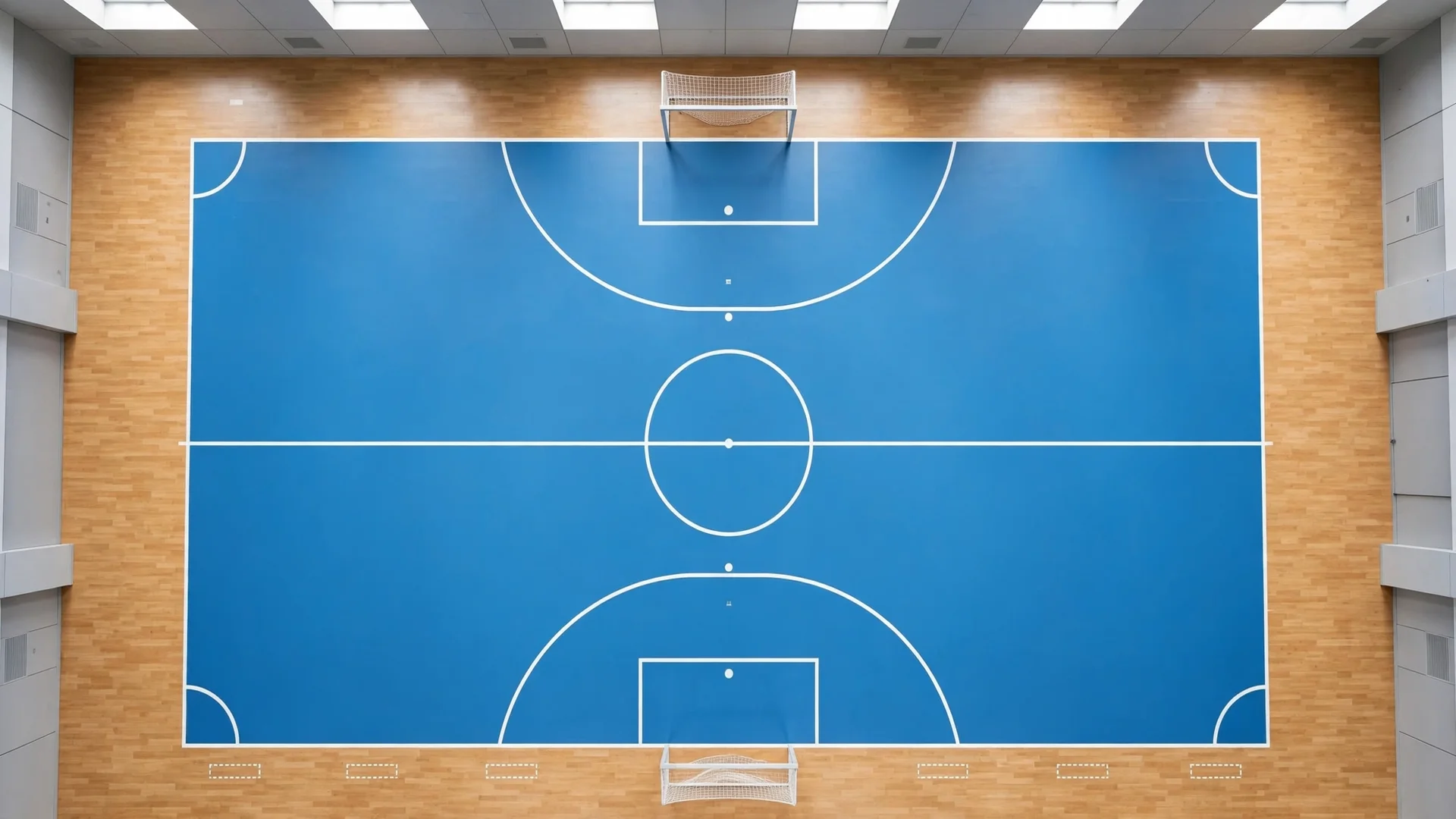
The standard court you’ll see at the World Cup or the AFCON is 40 metres long and 20 metres wide — exactly the size of a handball court, which is no coincidence since handball halls host a lot of futsal. One rule that always applies: the touchline (the longer sides) must be longer than the goal line (the shorter ends). All lines are 8 cm wide, and measurements are taken from the outside of the lines.
For local leagues, school tournaments, and casual games, organisers can pick any size inside the wider range. That’s why your neighbourhood court might be a touch narrower or shorter than the one you see on TV — and that’s perfectly legal.
Futsal Court Markings Explained
Once you know the size, the lines start making sense. Every marking on a futsal court has a job, and most of them revolve around one thing: keeping the game flowing in a tight space.
Center Circle
The court is split in half by the halfway line, and right in the middle sits the center circle with a 3-metre radius. Kick-offs happen from the center mark. Unlike football, where players bunch around the circle, futsal’s circle is mostly ceremonial — the game restarts so quickly that you’ll barely notice it.
Penalty Areas
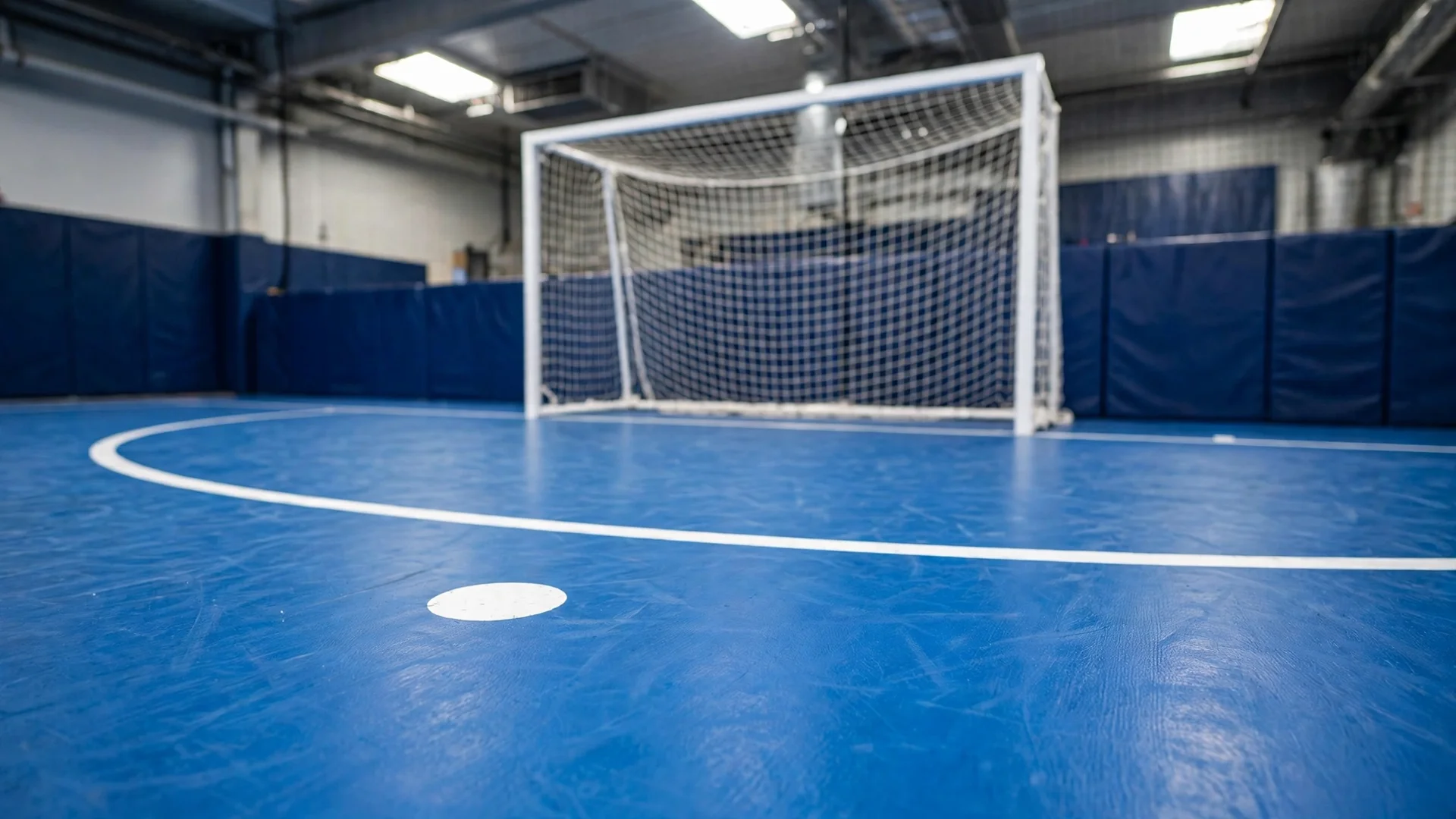
This is where futsal gets interesting. Each penalty area is drawn with two imaginary 6-metre lines running out from the outside of each goalpost at right angles to the goal line. At the end of those lines, quarter-circles with a 6-metre radius curve toward the nearest touchline, and the tops of the arcs are joined by a 3.16-metre line running parallel to the goal line.
The result is that distinctive rounded box you see in front of each goal. The big thing to know: this is the zone where the goalkeeper is allowed to handle the ball. Step outside it with the ball in hand, and it’s a foul.
Penalty Marks (6m & 10m)
Futsal has two penalty spots, which surprises a lot of football fans.
The first is the penalty mark, 6 metres from the midpoint between the goalposts — a small circular mark with a 6 cm radius. Fouls inside the penalty area mean a kick from here, just like you’d expect.
The second is the 10-metre mark, measured 10 metres out from the same midpoint. This one comes into play after a team commits six accumulated fouls in a half. From the sixth foul onward, the other team gets a direct free kick from the 10m mark (or from where the foul happened, their choice) with only the goalkeeper to beat. It’s one of futsal’s most dramatic rules — foul discipline genuinely decides games.
There’s also a lesser-known 5-metre line inside the penalty area that tells the goalkeeper how far back to stand during those 10-metre kicks. You won’t hear commentators mention it much, but referees watch it closely.
Goals
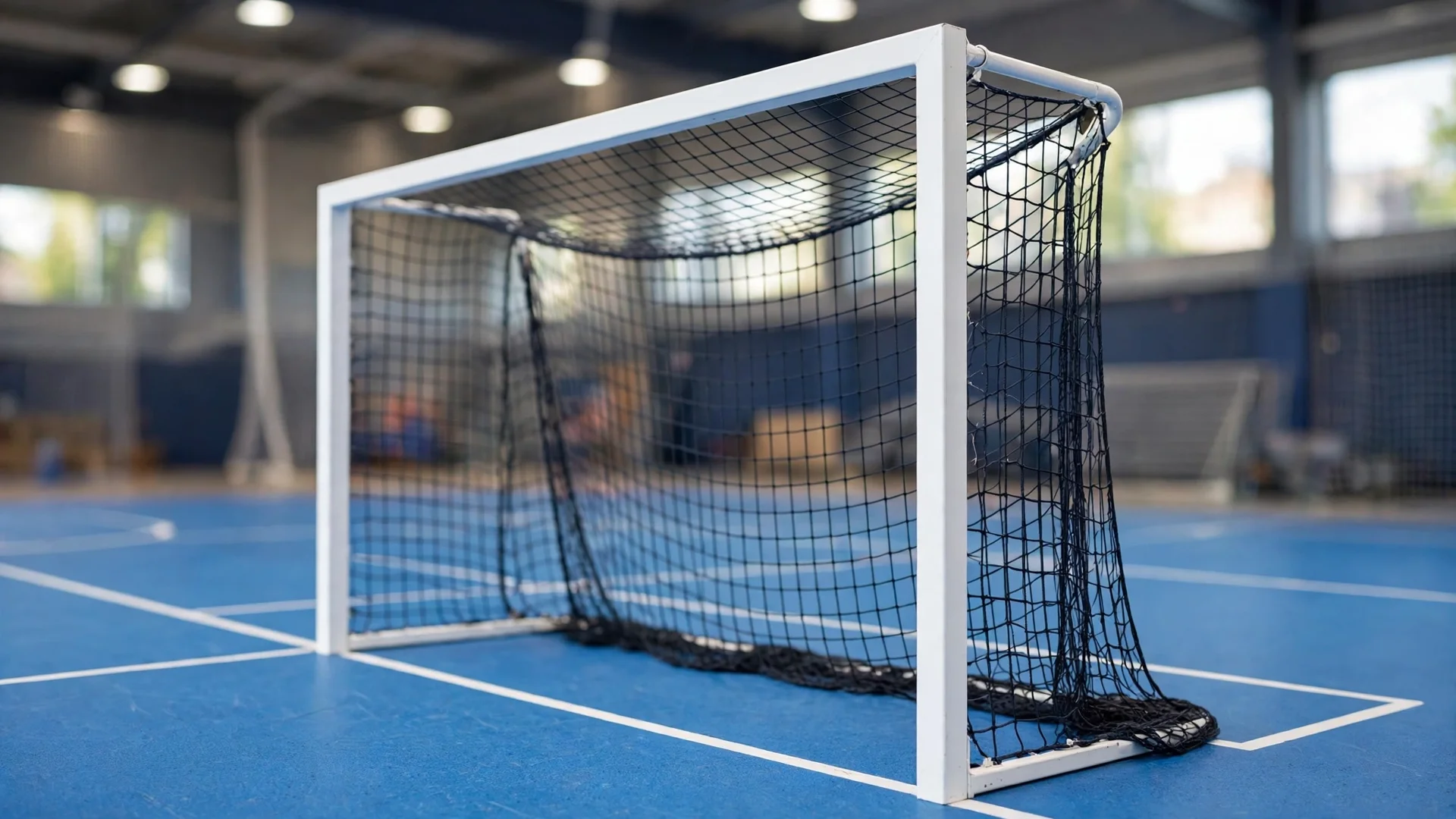
A futsal goal is 3 metres wide and 2 metres high — measured from the inner edges of the posts and the underside of the crossbar. The net runs about 80 cm deep at the top and a full metre at the bottom, which gives it that slightly tapered look.
If you’re used to football goals (7.32 m × 2.44 m), the futsal goal will look almost cute by comparison. But with only five players a side and shots flying from close range, keepers will tell you it feels plenty big enough.
Substitution Zones
Futsal is famous for its rolling “flying” substitutions — players hop on and off without stopping the game, a bit like ice hockey. That all happens in the substitution zones: marked areas on the touchline directly in front of each team’s bench, starting 5 metres from the halfway line.
The rule is simple but strict: your replacement can only step on once you’ve stepped off, and it all has to happen inside the zone. Get it wrong and you’re looking at a yellow card, which is why you’ll see substitutes hovering at the line like sprinters waiting for a baton. It helps to know your futsal positions before you try flying changes in a real game.
Touchlines & Goal Lines
The longer boundary lines are the touchlines; the shorter ones behind each goal are the goal lines. When the ball crosses a touchline, play restarts with a kick-in (not a throw-in — futsal ditched those). Cross the goal line and it’s a goal clearance or a corner, depending on who touched it last.
Each corner has a small quarter-circle arc with a 25 cm radius, marking where corner kicks are taken from. And one practical note from the Laws: halls hosting matches need a ceiling at least 4 metres high, because futsal goalkeepers love launching the ball the full length of the court.
Futsal Court vs Other Courts
It helps to put the numbers next to courts you might already play on:
- Basketball court: 28 m × 15 m — noticeably smaller and narrower than even the minimum futsal size. Fine for a kickabout (more on that below), but not legal for official futsal.
- Small-sided soccer (5-a-side): varies wildly, but usually around 30–40 m × 20–30 m. Overlaps with futsal’s range, though the markings, goals, and surfaces are completely different.
- Handball court: 40 m × 20 m — identical to the standard international futsal court. If your local hall hosts handball, it can host proper futsal too.
The surface matters as much as the size. FIFA calls for wood or synthetic material — smooth, flat, and non-abrasive. Concrete and tarmac are out, and artificial turf isn’t accepted for international matches. That’s a big part of why futsal feels so different from street 5-a-side: the ball zips across a proper court instead of bobbling over rough ground. The full futsal rules cover the surface requirements in detail.
Futsal Court Dimensions FAQs
Can you play futsal on a basketball court?
Yes, for casual games — a 28 × 15 m basketball court works fine for a kickabout with friends, and plenty of people start exactly that way. Just know it’s below FIFA’s minimum width (16 m) for official matches, so you won’t see competitive futsal played on one. The goals and markings will be improvised too, which is half the fun at that level.
What is the best surface for a futsal court?
Wood is the classic choice — think of the gleaming halls you see at World Cups — but modern synthetic surfaces are just as common and a bit more forgiving on joints. What matters is that it’s smooth, flat, and non-abrasive so the low-bounce futsal ball rolls true. Avoid concrete or tarmac: they’re harsh on the ball, harsh on your knees, and not permitted in the Laws of the Game anyway.
How big is a futsal goal compared to a soccer goal?
A futsal goal is 3 m wide and 2 m high. A full-size soccer goal is 7.32 m wide and 2.44 m high — so the futsal goal is less than half the width. It sounds easy to defend until you remember there are only four outfield players, the shots come from 6 metres out, and the ball moves absurdly fast on a hard court. Goalkeepers earn every save. New to the sport? Start with our what is futsal guide.
Do futsal court dimensions change for kids or youth games?
FIFA’s ranges already allow for it: any competition can set its own dimensions within the 25–42 m by 16–25 m band, so youth tournaments routinely use smaller courts to suit younger players. There’s no separate official “kids’ size” in the Laws — it’s up to the competition organisers. If you’re setting up a youth league, scaling down toward the 25 × 16 m end of the range keeps the game age-appropriate.
Final Thoughts
The beauty of futsal court dimensions is that they’re strict where it matters — the 6-metre arcs, the two penalty marks, the 3 × 2 m goals — and flexible where it counts, letting local leagues fit the game into whatever hall they’ve got. Whether you’re playing on a full 40 × 20 m international court or a converted school gym, the lines tell the same story: small space, quick thinking, and non-stop action.
Now that you know the court inside out, the next step is understanding who does what on it — and that’s a whole other guide.