
Futsal Formations Explained: 2-2, 3-1, 1-2-1, 4-0 and Every System Your Team Can Use
Pick a futsal formation and you are not just picking where five players stand at kick-off. You are picking how your team attacks, how it defends, and how much risk it takes when the ball changes hands. On a small court where play never really stops, a formation is less a fixed shape than a starting point for constant rotation — but the shape you start from still decides which passing lanes open up and how exposed your goal is when a move breaks down.
This guide walks through every formation used in modern futsal — the 2-2 box, the 3-1, the 1-2-1 diamond, the 2-1-1, the fluid 4-0, and the fly-goalkeeper 5v4 — with honest strengths, weaknesses, and the players each needs. Still getting the roles straight? Start with our guide to futsal positions, which explains what the goleiro, fixo, ala and pivot each do. Formations are simply those roles arranged differently
The 2-2: The Box
The 2-2 is where most teams begin, and plenty of good teams never leave it. Two players sit deep, two play high, and the four outfielders form a box.
    Opponent goal

      Ala        Pivot

      Fixo       Ala

    Your goal (Goleiro)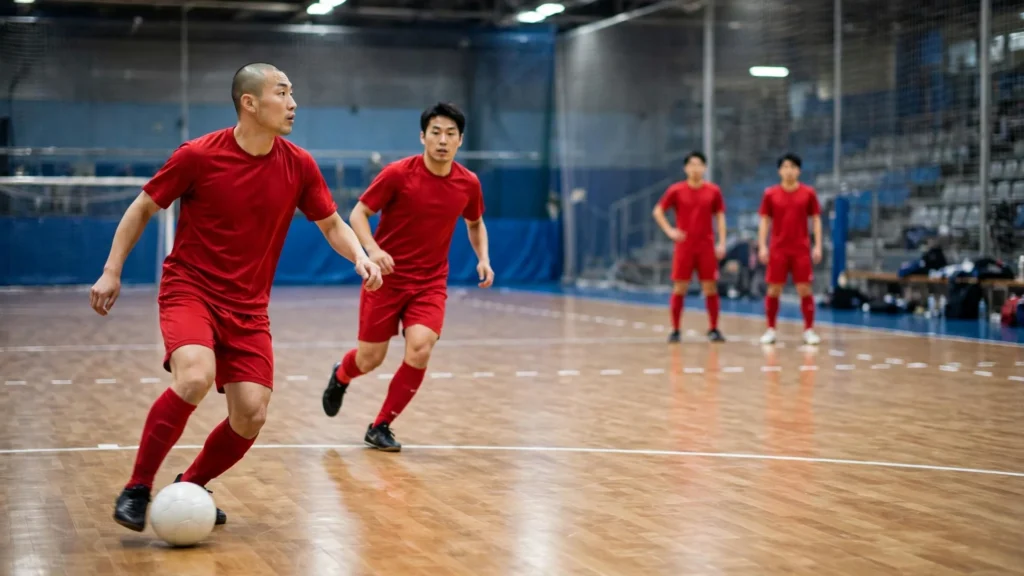
How it plays. The two deep players — usually the fixo and one ala — build from the back. The two high players stretch the court: the pivot pins the last defender while the second forward works beside him. It is easy to teach and easy to fall back into after a scramble, which is why youth and amateur coaches love it.
Strengths. Balance. You attack with two, defend with two, transitions are simple, and one player caught up-court does not collapse the shape.
Weaknesses. The box can turn static. The two lines play in straight lines, the centre is left empty for clever opponents to pass through, and the deep players’ passing is heavily tested — there is no third option behind the ball.
When to use it. With beginners, a new squad, or any time you want a stable base against a team of similar strength.
Players it needs. A composed fixo who passes well under pressure, two hard-running alas, and a pivot who holds the ball up.
The 3-1: Built Around the Pivot
The 3-1 is the classic formation of traditional futsal: a fixo in the middle with an ala each side, and one pivot alone against the opposition defence.
    Opponent goal

         Pivot

  Ala     Fixo     Ala

    Your goal (Goleiro)
How it plays. Everything flows through the pivot. The three base players circulate the ball, looking for the pass into his feet. He turns and shoots, or lays it back for an ala arriving at speed — the famous one-touch patterns of Spanish and Brazilian futsal are built on this shape. When the alas push on it can resemble a 1-2-1 in attack; the difference is where players recover to when possession is lost.
Strengths. A permanent target up front, a safe three-player base behind the ball, and natural width. Three players are rarely caught ahead of play, so cover is strong.
Weaknesses. The system leans on one man. Mark the pivot tightly — or cut the passing lane into him — and the attack stalls. He plays a lonely, physical game with his back to goal, and if he tires, the formation loses its point.
When to use it. When you have a genuine pivot — strong, good with his back to goal, able to finish. It is also a sound choice when protecting a lead, because the base of three keeps the game controlled.
Players it needs. A real pivot is non-negotiable. Behind him, a fixo who reads the game and alas who time their runs to arrive as he lays the ball off.
The 1-2-1: The Diamond
On paper the 1-2-1 looks almost identical to the 3-1 — coaches argue about the labels — but the diamond is staggered rather than flat: one fixo at the base, two alas higher and narrower, the pivot on top.
    Opponent goal

         Pivot

      Ala     Ala

         Fixo

    Your goal (Goleiro)
How it plays. The staggered lines create passing angles in every direction, making the diamond a pressing shape as much as an attacking one. The middle pair combine quickly, and when the ball is lost the nearest ala jumps onto the carrier while the fixo screens the middle.
Strengths. Compactness and angles. Hard to play through, presses well, and gives the player on the ball two short options plus the long ball into the pivot.
Weaknesses. Width. With the alas narrower, the far touchline can be left open and switching play is harder. The fixo also covers a huge area alone if both alas are beaten.
When to use it. Against teams that build through the middle, or when your squad is fit and happy defending on the front foot.
Players it needs. Mobile, aggressive alas who can press and recover, and a fixo with real defensive range.
The 2-1-1: Two Lines and a Link Man
The 2-1-1 splits the difference: two at the back, one midfielder linking play in the centre, one pivot at the top.
    Opponent goal

         Pivot

         Ala

      Fixo    Ala

    Your goal (Goleiro)
How it plays. The central player is the hinge. Defensively he screens the fixo line and blocks passes into the opposing pivot; in attack he pushes on and turns the shape into a diamond. Think of it as the box with one corner pulled into the middle.
Strengths. A permanent presence in the centre — the space the 2-2 leaves empty. It suits teams whose best player is a creative central ala rather than a pure finisher.
Weaknesses. The link man can be overloaded: outnumbered when opponents flood the middle, isolated when your pivot drops deep, with the wide areas behind him opening up.
When to use it. Against a 3-1 team whose pivot you want to screen from the front, or when your squad has a standout playmaker but no classic pivot.
Players it needs. A high-energy central player, plus disciplined wide players who tuck in when he goes forward.
The 4-0: No Pivot, Total Rotation
The 4-0 is the most demanding — and most modern — system in futsal. All four outfielders play in one line, there is no fixed pivot, and the shape survives only through constant rotation.
    Opponent goal

  Ala    Ala    Ala    Ala

    Your goal (Goleiro)
How it plays. Players swap positions continuously: an ala cuts inside, the fixo fills the space he vacated, the far-side player balances the line. The aim is to drag markers out of position and open a lane for a third-man run. Elite sides such as Barcelona’s futsal team have used the 4-0 to pull man-marking defences apart. There is no target man to mark — which is precisely the point.
Strengths. Unpredictability. Man-markers get pulled everywhere, space appears where no static formation creates it, and all four players join every attack.
Weaknesses. Exhausting and unforgiving. One player switching off breaks the line, turnovers leave no cover, and poorly rehearsed rotations leave a flat line passing sideways.
When to use it. With a technically strong, well-drilled squad — or for short spells against a defence that man-marks and follows your pivot everywhere.
Players it needs. Four interchangeable players, all comfortable receiving under pressure. There is no hiding place.
The 5v4: The Fly-Goalkeeper Power Play
The fly goalkeeper is not a formation you start with — it is the one you finish with. Losing late, a team replaces the goalkeeper with an extra outfield player (or pushes him up), creating a 5-against-4 overload. The rules for how the fly keeper works — the different-coloured shirt, the four-second limits — are covered in our futsal rules and regulations guide.
    Opponent goal

    Pivot        Ala

         Ala

    Ala      Fly GK

    Your goal (EMPTY)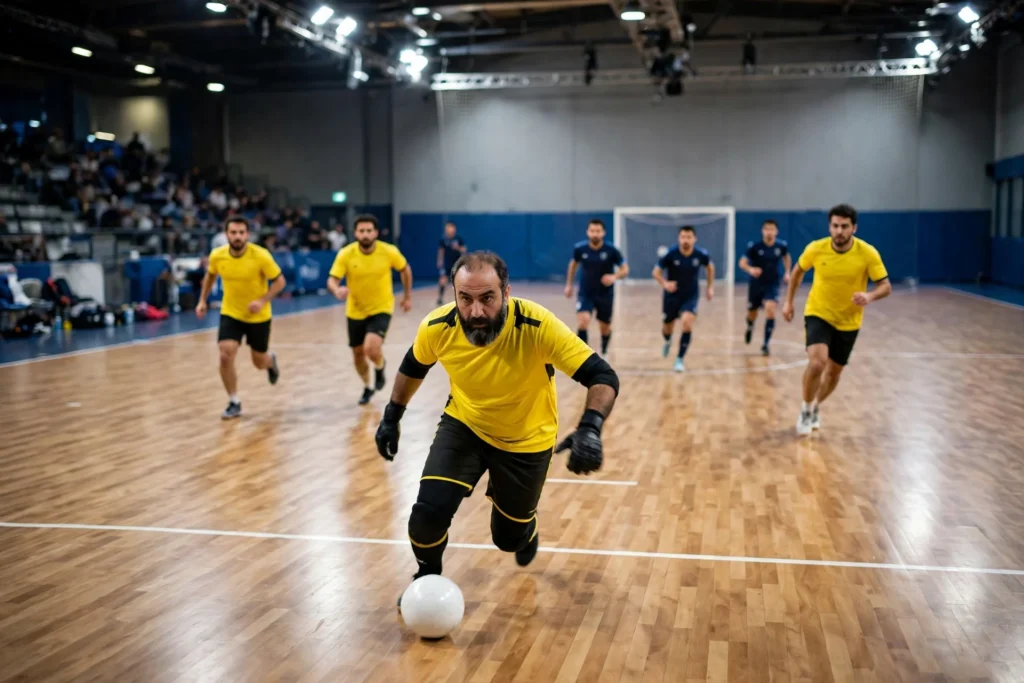
How it plays. The extra player sits deep as a safe passing option while four attackers work the ball around the box, waiting for the defence to tire, lunge, or lose a man at the far post. Most 5v4 goals come from patience: side to side, then one quick pass through a gap.
Strengths. A permanent spare man, total control of possession, and a real chance of late goals against a tiring defence.
Weaknesses. Your goal is empty. One interception gives the opponent a free shot from anywhere — many fly-keeper spells end with the chasing team conceding instead. It also demands rehearsed patterns; passing in hope rarely breaks a set defence.
When to use it. When you are behind late and a draw or win is worth the gamble. Most coaches set a trigger — two down with five minutes left, say — rather than deciding in the heat of the moment.
Players it needs. A calm extra man who passes well and never switches off, and shooters patient enough not to force low-percentage shots.
How to Choose the Right Formation
Forget the ‘best’ formation in the abstract. Choose for your players and the game in front of you.
- Start with your pivot. A strong target man makes the 3-1 or 1-2-1 the obvious base. No natural pivot? The 2-2 shares the load; the 4-0 removes the role entirely.
- Count your legs. Pressing shapes like the diamond need fit, aggressive alas. A less mobile squad is safer in a 2-2 or 3-1, where distances are shorter.
- Read the score. Level or ahead, balanced shapes protect you. Behind late, caution helps nobody — that is when the fly keeper earns his shirt.
- Watch the opponent. Man-markers can be pulled apart by rotation (4-0, or a 3-1 with swapping alas). A zonal defence is better attacked with a pivot pinning the last man.
- Change in spells, not seconds. Rotate fresh players freely, but change the shape itself at planned moments — a timeout, half-time, your fly-keeper trigger — not on impulse.
Playing Against Counter-Attacking Teams
Fast-break teams want you stretched, committed, and careless with the ball. Your formation is your first line of defence against them.
Keep numbers behind the ball: the 3-1’s base of three and the 2-2’s deep pair leave cover when an attack breaks down, while the 4-0 and a reckless diamond can leave your fixo alone against two runners. Insist on rest defence — at least two players goal-side whenever you attack — and make your furthest ala recover the moment a pass is intercepted. A tactical foul high up the court stops a counter early, though with accumulated fouls leading to second-penalty shots, use it sparingly. Finally, slow your own build-up: a patient 3-1 that makes them defend for long spells takes away the game they want.
All Futsal Formations Compared
| Formation | Shape | Best for | Main risk | Key player |
|---|---|---|---|---|
| 2-2 | Box: two deep, two high | Beginners, balanced games | Static play, empty centre | Composed fixo |
| 3-1 | Three base + lone pivot | Playing through a target man | Over-reliance on the pivot | Strong pivot |
| 1-2-1 | Diamond | Pressing, compact midfield | Little width, fixo exposed | Mobile alas |
| 2-1-1 | Two lines + link man | Controlling the centre | Link man overloaded | Creative central ala |
| 4-0 | Flat four, no pivot | Beating man-marking | Turnovers, exhaustion | Four all-rounders |
| 5v4 | Fly keeper overload | Chasing a game late | Empty net | Calm fly keeper |
Frequently Asked Questions
Can a team change formation during a match?
Yes, and good teams do it constantly. With unlimited substitutions and fluid positions, a side might attack in a 3-1, defend in a 2-2, and finish with the fly keeper. The numbers describe where players recover to, not cages.
What is the best futsal formation for beginners?
The 2-2. It is balanced, easy to understand, and forgiving: two players are always back, two always forward, and nobody must master a specialist role before the team functions.
Why don’t futsal formations look like football formations?
Scale. With four outfielders, everyone is close to both goals — no room for the layered lines of 11-a-side. Futsal shapes look simpler but rotate far more: an ala might defend like a full-back and attack like a winger in one move.
Does the formation change how the goalkeeper plays?
More than most people expect. In a 3-1, the goleiro is often the spare passer who starts attacks. In a 4-0 he joins the rotation when building from deep. In the 5v4 he may not be on the court at all.
Is the 4-0 only for professional teams?
Mostly, yes — it demands technique, fitness and rehearsed rotations that take months to build. Amateur teams can still borrow the idea in short spells: when a defence follows your pivot everywhere, five minutes without a fixed target unsettles them.
Which formation concedes the fewest goals?
On paper, the 3-1 and 2-2, which keep at least two — usually three — players behind the ball. In practice, futsal goals come more from turnovers and slow recovery runs than from the shape on the team sheet, so the best defensive formation is the one your players actually understand.