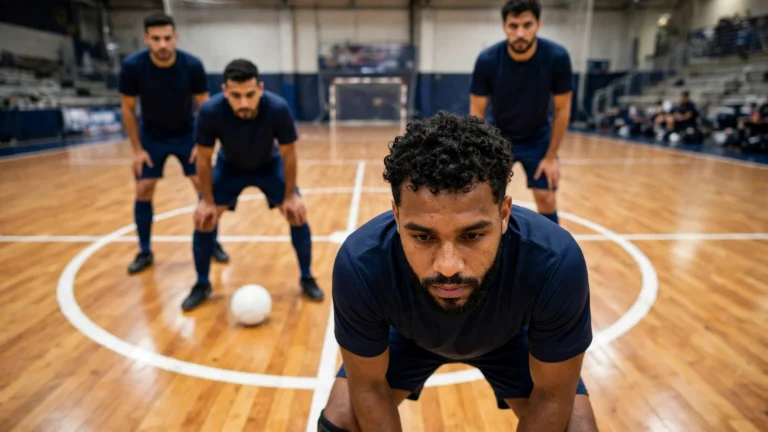
Futsal Pivot Role Explained: The Target Player Who Makes the Attack Work
Watch any good futsal team for five minutes and one player will keep drawing your eye: the one standing with his back to goal, a defender glued to him, taking the ball in the tightest space on the court and somehow making something happen. That player is the pivot, and in many ways he is the whole attack in miniature. He is the target, the wall, the finisher and the decoy, all in one shirt.
This guide explains what the pivot actually does, where he plays, the skills the role demands, how different teams use him, and how to play — or defend — against him. If the shapes themselves are new to you, start with our guide to futsal formations which shows where the pivot sits in the 2-2, 3-1, 1-2-1 and 4-0. If the other roles are unclear, our guide to futsal positions explains what the goleiro, fixo and ala each do. The pivot’s movement is also the engine of much of what is covered in futsal tactics and strategies — pressing triggers, rotation and the wall pass all run through him.
What Is a Pivot?
The pivot is the furthest-forward outfield player. He plays on the edge of the opposition’s area, usually with his back to goal, and his first job is to receive the ball where there is almost no space — and keep it.
That sounds simple. It is not. The pivot is marked tighter than anyone else on the court, because everyone in the hall knows the ball is going to him. He receives passes that arrive at pace, with a defender’s hands on his back and another defender ready to double up the moment he turns. His first touch has to be perfect, because there is no second one: a heavy touch in that position is a turnover ten metres from your own goal the other way.
The role’s name gives away its function. A pivot is a fixed point the rest of the attack turns around. The ball goes into him, the team moves off him, and the ball comes back out — to an ala arriving at pace, to a fixo stepping up for a shot, or back into the pivot himself, now facing goal. When it works, the pivot barely seems to move; everyone else does the running. When it does not work, the whole attack stalls, because there is nobody to play off.
One thing the pivot is not: a striker in the football sense. A football centre-forward can wait for service, make runs in behind and live on a handful of chances. A pivot touches the ball constantly, in every attack, and most of those touches are not shots. Holding, laying off, screening, decoying — the unglamorous work is the job.
Where the Pivot Plays
The pivot’s home is the central lane, roughly five to eight metres from the opposition goal, between the two defenders who guard that area. He rarely drifts wide for long, because the moment he leaves the centre, the middle of the court empties and the defence can push up.
That does not mean he stands still. Good pivots are always adjusting by a step or two: dropping half a metre to open a passing lane, stepping to the blind side of a defender so the pass can arrive, or pinning one defender so the other cannot step out. The movement is small and constant, and it is timed to the ball, not to a plan — when the fixo has it, the pivot shows for the pass; when an ala has it wide, the pivot attacks the far post.
In text, the shape looks like this — the pivot (P) on the edge of the area, the fixo (F) deep, the
two alas (A) wide:
    opposition goal
 [==== GOAL ====]
      (P)
 A              A
        F
    (goleiro)
In the 3-1, the pivot is a fixed, named role: one player, stationed high, with the fixo behind him and two alas either side. In the 2-2, the “pivot” is less fixed — either of the two forwards can step up into the pivot’s spot depending on where the ball is, and they swap constantly. In the 4-0 there is no pivot at all, by design: all four players rotate, and whoever arrives in the central lane becomes the pivot for that attack, then leaves again. The 1-2-1 diamond keeps a pivot at the tip, but he is expected to drop deeper and link play more than a 3-1 pivot does. Knowing which system your team plays tells you which kind of pivot you need — and it is a different player in each one.
The Five Skills a Pivot Cannot Do Without
Every good pivot has the same toolkit, in roughly the same order of importance.
1. Receiving with his back to goal. The first touch is everything. The pivot receives the ball with a defender pressing his back, so the touch has to do three things at once: kill the pace of the pass, keep the ball within reach, and set up the next action. The best pivots receive across their body, on the sole of the foot — futsal’s signature trap — so the ball stops dead and they can
choose: turn, lay off, or shield. A pivot who needs two touches to control the ball will never get
the second one.

2. Shielding and holding the ball. Once the ball arrives, the pivot’s body becomes a wall. He gets low, gets his hips between the ball and the defender, and uses his arms — legally, within reason — to feel where the defender is. The aim is not to beat the man, but to buy two seconds: long enough for an ala to make a run, or for the fixo to step up. Strength matters here, but balance and timing matter more. A pivot who leans into the defender at the wrong moment gets spun; one who stays square and low is almost impossible to move.
3. The lay-off. Most pivot touches end in a pass backwards, not a shot. The pivot receives, holds, and lays the ball back first-time to a teammate arriving at speed — the wall pass that the tactics guide covers in detail. The quality of the lay-off decides the quality of the chance: it has to
be into the runner’s path, at the right pace, with the defender screened. A sloppy lay-off kills the move; a perfect one is an assist that never appears in the statistics.
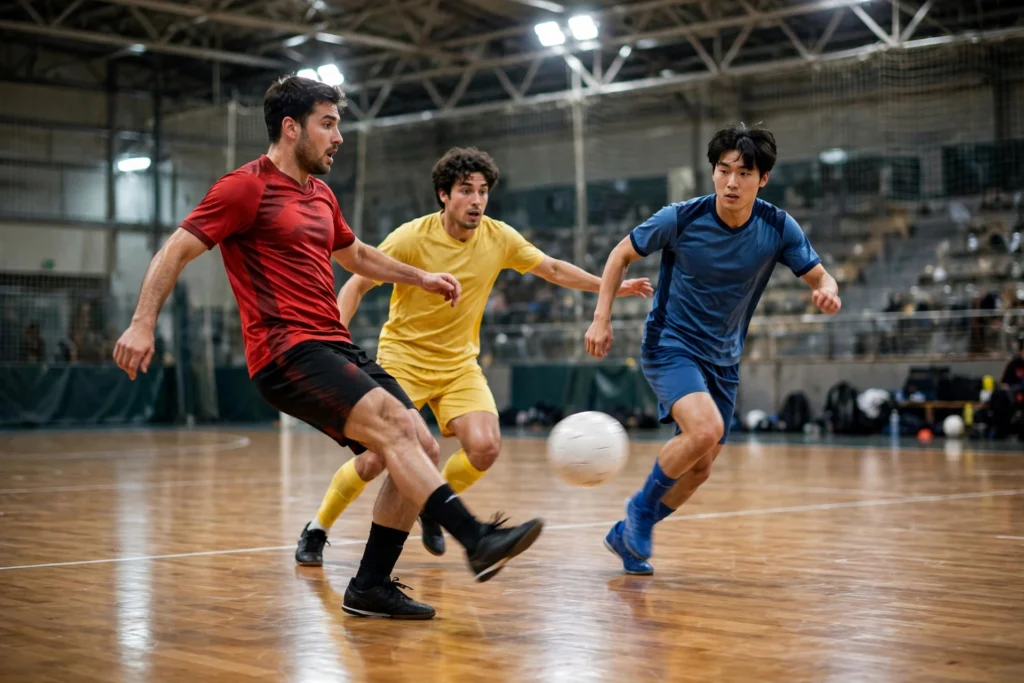
4. Turning and shooting. When the defender over-commits or the pass arrives with the pivot already half-turned, the pivot spins and shoots. The turn is usually a single movement — a drag-back with the sole, a roll across the defender, a sharp pivot on one foot — and the shot follows immediately, before the covering defender arrives. Pivots score from very close range, so
placement beats power: low, into the corner the goalkeeper has just left, is worth more than a blast at the keeper’s chest.
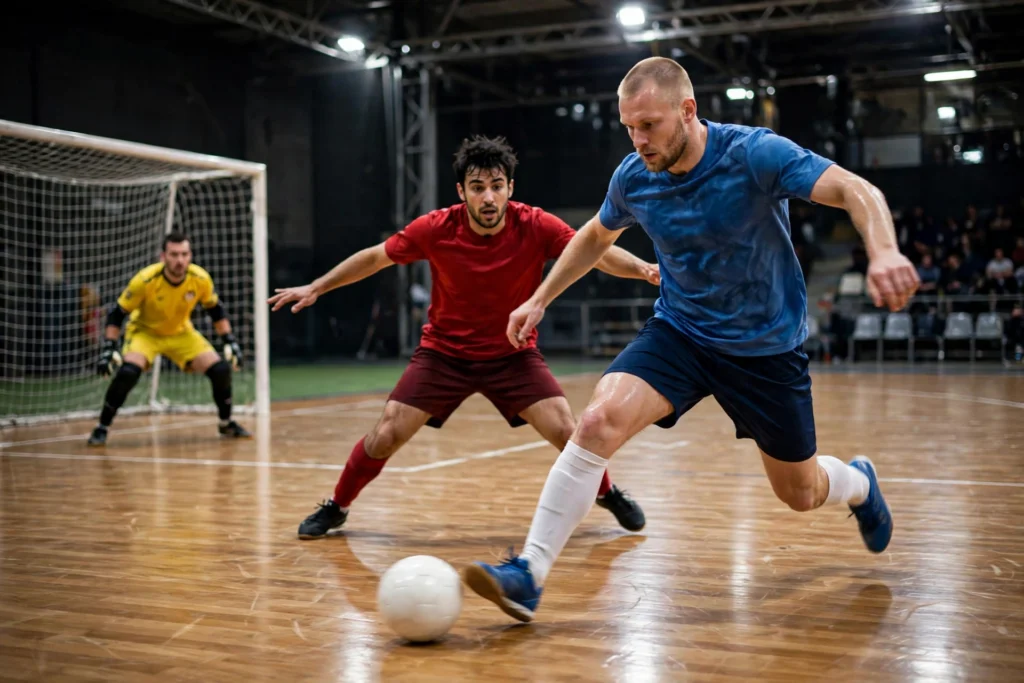
5. Movement off the ball. The pivot’s runs are short and sharp: a step towards the ball to drag a defender out, then a spin in behind; a decoy run to the near post that opens the far post for an ala; a sudden drop deep that leaves the centre empty for a late runner. He is rarely the fastest player on the court. He does not need to be — his runs are five metres long, and the timing is the speed.
Types of Pivot: One Role, Three Very Different Players
Not all pivots play the same way. Coaches pick the type that fits their system — and their squad.
The target pivot. Big, strong, and almost impossible to push off the ball. The target pivot’s job is to win the physical battle: receive long balls, hold off two defenders, and bring teammates into play. He scores from lay-offs and rebounds as much as from his own turns, and he is at his best against teams that defend deep, where there is no space to run into anyway. His weakness is mobility — ask him to press high or rotate constantly and he will be blowing hard by the second half.
The mobile pivot. Smaller, quicker, always moving. The mobile pivot rarely holds the ball for long; he receives, turns, and is gone, or he lays it off and spins into the space behind the defence. He thrives in teams that play the 4-0 rotation or a fluid 2-2, where the pivot’s spot is shared and nobody stays still. Against a deep defence he can struggle — there is nothing to run
behind — but in transition he is the most dangerous player on the court.
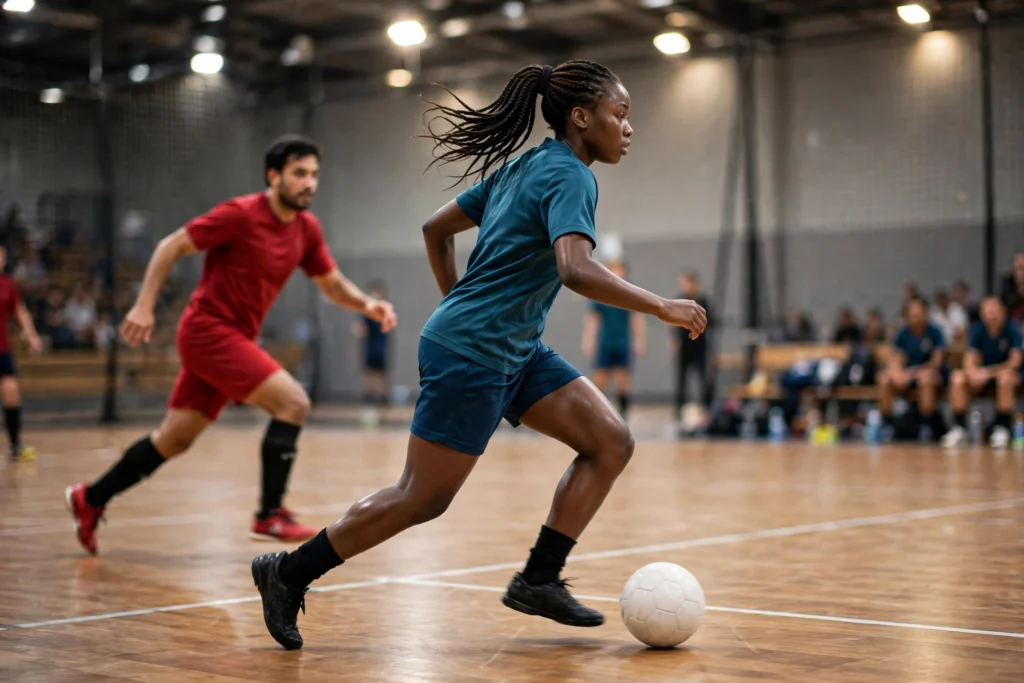
The false pivot. The least obvious type, and the most disruptive. The false pivot starts in the pivot’s position, then drops deep — into midfield, sometimes almost to his own fixo — dragging a defender with him and leaving the centre of the attack empty. Into that empty space runs an ala or a fixo, arriving late and unmarked. It only works if the rest of the team understands it: if nobody fills the space the false pivot leaves, the attack simply has no one up front. Used sparingly, against a man-marking defence, it breaks the marking system completely.
Most teams do not choose one type and stick to it for a whole match. They change pivot — a rolling substitution brings on a fresh target pivot to protect a lead, or a mobile one to chase a game — and the change of pivot changes the whole attack without changing the formation.
How Teams Actually Use the Pivot
The pivot’s role looks different depending on the game state, because coaches use him as a tool for different jobs.
As a wall. The classic use, and the one every beginner team should learn first. The ball goes into the pivot, the pivot lays it back, an ala shoots. The pivot never turns, never shoots, never tries anything clever — and the team creates its best chances. It is boring, reliable and almost impossible to defend if the lay-offs are accurate, because the defence has to mark both the pivot and the runner, and it cannot mark both.
As a decoy. Sometimes the pivot’s job is to do nothing with the ball at all. He pins two defenders simply by standing in the right place, and the attack goes around him — the alas combine wide, the fixo shoots from distance, the far-post runner scores. The pivot’s movement still matters here: a decoy run to the near post that drags the last defender with it is what opens the far post. Teams that only ever play through the pivot become predictable; teams that use him as a decoy keep
the defence guessing about where the danger is coming from.
In set pieces. The pivot is central to corners and kick-ins. He screens the goalkeeper, blocks the defender who would clear the ball, or makes the near-post run that the whole routine is built around. A well-drilled corner in futsal is often a pivot’s goal: a low ball across the face of goal, the
pivot arriving late at the far post, the defence still watching the taker.
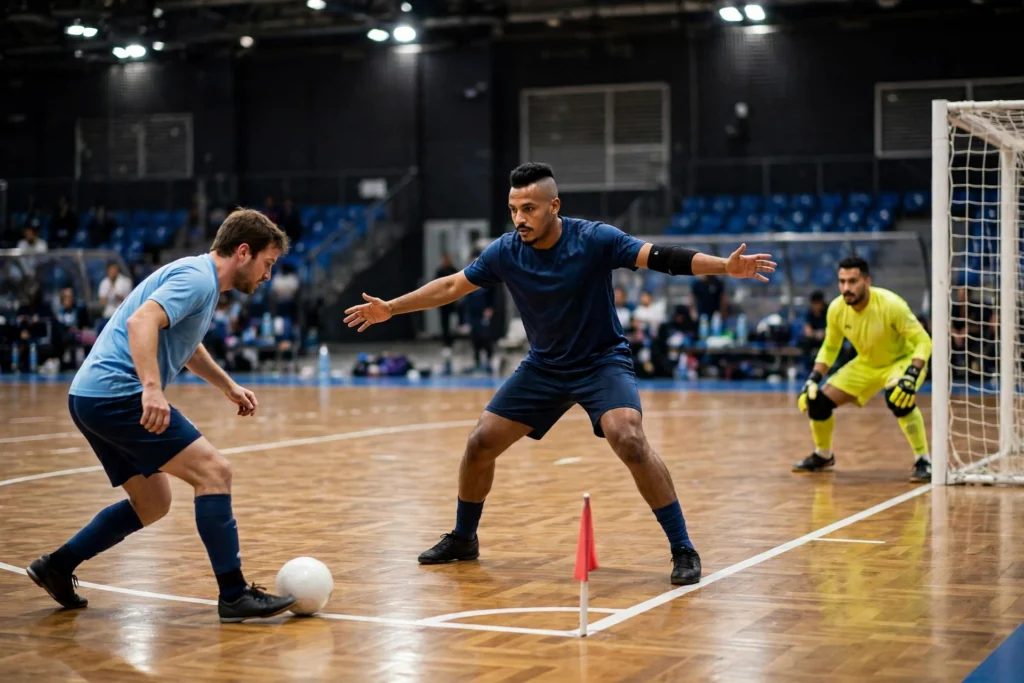
As the first defender. The pivot’s job does not end when his team loses the ball. He is the first presser — the player who closes down the opposition goleiro or fixo and forces the first pass to go where his team wants it to. A pivot who jogs back after losing the ball leaves his team defending 3v4; a pivot who presses immediately, even for three seconds, gives his teammates time to get back into shape. Coaches notice this more than fans do, and it is often the difference between a pivot who stays on the court and one who gets substituted.
Late in games. Chasing a goal, teams play even more through the pivot — long balls, hopeful crosses, anything into the area. Protecting a lead, the pivot’s job flips: hold the ball in the corner, win fouls, slow the game down, and never, ever lose it in a dangerous area. The best pivots understand both jobs and switch between them without being told.
Defending Against a Pivot
Stopping a pivot is a team job, and teams that leave it to one defender usually lose.
Deny the pass in. The cheapest way to stop a pivot is to stop the ball reaching him. The defender marking the pivot stays goal-side and tight; the other defenders cut the passing lane from the fixo. If the pass cannot arrive cleanly, the pivot spends the game wrestling for scraps instead of linking play.
Double up at the right moment. One defender presses the pivot’s back, the second arrives the moment the ball does — not before, or the pivot simply lays it off into the space the second
defender left. The timing is everything: double too early and you concede a 3v2 the other way;
double too late and the pivot has already turned.
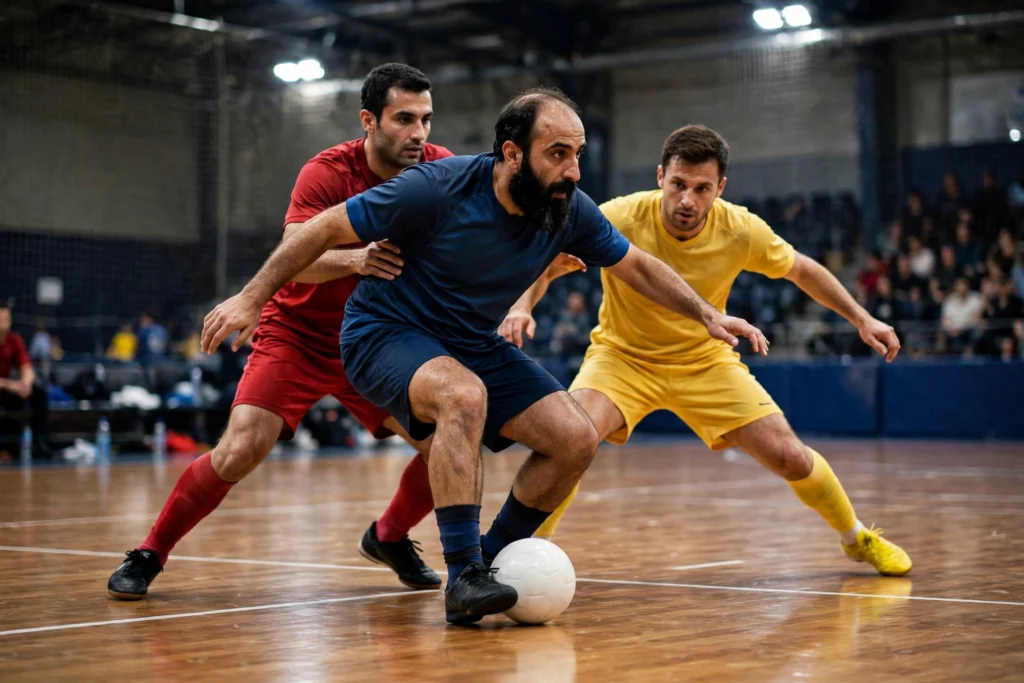
Force him one way. A pivot who can turn both ways is almost unmarkable. Defenders show him to his weaker side — usually onto his weaker foot, or towards the touchline where there is less space — and the rest of the team knows which way he is being forced, so the cover is already there.
Do not foul him cheaply. The pivot wins fouls. He draws contact by shielding the ball and letting the defender reach around him, and a frustrated defender who grabs or pushes gives away a free kick in a dangerous area — or worse, an accumulated foul that brings the second penalty closer. The rules on fouls and accumulated fouls are covered in our futsal rules and regulations guide. Disciplined teams defend the pivot with their feet and their positioning, not their hands.
How to Play as a Pivot: Advice for Beginners
If you are the tallest or strongest player in your team, you will probably be asked to play pivot. Here is how to make it work from the first game.
Get side-on before the ball arrives. Do not stand square to the defender with your back flat against him. Get half-turned, so you can see the ball and the goal at the same time, and so your first touch can go in either direction. The half-turn is the single most useful habit a young pivot can learn.
Receive on the sole. Let the ball roll onto the sole of your foot and stop it dead. It looks unhurried, and that is the point — a stopped ball gives you a choice, a bouncing ball gives the
defender one.
Lay it off before you turn. Your first instinct should be the simple pass back to a teammate, not the spectacular turn. Turn only when you feel the defender’s weight shift the wrong way, or when you are already half-turned and the goal is in front of you. The pivot who lays off nine times and turns once is far more useful than the one who tries to turn ten times and loses the ball eight times.
Talk constantly. The pivot sees the whole court in front of him, and his teammates behind him cannot see what he sees. Call the runner in, tell the ala when to go, warn the fixo when the press is coming. The pivot is often the team’s second playmaker, after the fixo — and the loudest.
Stay fit enough for the role. The pivot’s work is short, sharp and physical: hold, turn, sprint five metres, hold again. It is exhausting in a different way from running up and down the wing. Train for it with short bursts and strength work, not just long runs, and use the rolling substitutions — a fresh pivot for the last five minutes is worth more than a tired one who has played the whole half.
Common Pivot Mistakes
Trying to turn every time. The most common beginner error, and the most expensive. Every failed turn is a turnover in the worst place on the court. Turn when the defender gives you the chance, not because you feel you should.
Drifting wide. The pivot who keeps wandering to the wing leaves the centre empty, and the attack has nowhere to go. Stay central, even when the ball is not coming to you — your position is doing work even when you are not touching the ball.
Standing still off the ball. The opposite error: the pivot who plants himself on the spot and waits. Defenders love a stationary pivot. Move a step, check to the ball, spin away — keep the
marker guessing, even when nothing is happening.
Ignoring the defensive job. The pivot who switches off when his team loses the ball is a liability, however good he is with it. The first three seconds of pressing are part of the role, not an optional extra.
Holding the ball too long. Two seconds is usually enough. Hold it longer and the defence recovers, the runners stop, and the attack dies. The pivot’s art is quick decisions: lay off, turn, or shoot — and then do it.
Pivot vs the Other Roles
| Role | Main area | First job | What makes a great one |
|---|---|---|---|
| Pivot | Edge of the opposition area, back to goal | Receive, hold, link the attack | First touch, strength, lay-offs |
| Ala (winger) | Wide, both sides | Beat a man, cross, arrive late at the far post | Pace, 1v1 skill, timing of runs |
| Fixo (defender/playmaker) | Deep, in front of the goleiro | Start attacks, organise the defence | Passing range, reading the game, discipline |
| Goleiro (goalkeeper) | Goal, stepping out with the ball | Save, then start the build-up | Shot-stopping, distribution, nerve |
The pivot and the fixo are the two players the whole system turns on: the fixo starts the attack from deep, the pivot finishes the build-up at the top. The alas are the runners who connect them. Change any one of the four and the team plays differently — which is why coaches build their system around the pivot they have, not the pivot they wish they had.
Frequently Asked Questions
Is the pivot the same as a striker?
Not quite. A striker’s main job is to score; a pivot’s main job is to receive the ball with his back to goal and bring teammates into play. Pivots do score — often a lot — but a pivot who never shoots and lays off perfectly is still doing the job. A striker who never shoots is not.
Does every futsal team need a pivot?
Every team needs someone in the pivot’s position, but not every system names a fixed pivot. In the 3-1 there is one dedicated pivot; in the 2-2 the role is shared between two forwards; in the 4-0 there is no fixed pivot at all, and whoever rotates into the central lane plays the role for that attack. The function is always there — the player filling it changes.
What makes a good pivot — size or skill?
Both help, but the order matters: first touch and decision-making first, physical presence second. A small pivot with a perfect first touch and quick lay-offs causes more problems than a big pivot who cannot control the ball under pressure. Size decides which kind of pivot you are; skill decides whether you are any good at it.
Why do pivots get so many fouls against them?
Because defenders have to foul them to stop them. A pivot shielding the ball legally forces the defender to reach around him or push through him, and both are fouls. It is one of the role’s hidden values: a pivot who wins fouls in the opposition half is also pushing his team towards the second-penalty zone — the opposition’s sixth accumulated foul in a half gives a direct shot from ten metres.
Can a pivot also be the fly goalkeeper?
Rarely, and only in very specific situations. The fly goalkeeper needs to be a strong passer who is comfortable deep, which is the fixo’s skill set more than the pivot’s. The pivot’s value is at the top of the court, not the bottom — taking him out of the area to play fly goalkeeper removes the target the 5v4 attack is supposed to feed.
How do I know if I should play pivot?
If you are comfortable receiving the ball with someone pressing your back, you enjoy the physical battle, and you would rather lay off a perfect pass than take a wild shot yourself, the role will suit you. If you hate contact, prefer space to run into, and want to face the goal all the time, you will probably be happier as an ala — and your team will be happier for it too.